 Minswap
 liquidity comparisons help assess pool conditions and deposit compatibility before adding assets
Minswap liquidity should be judged by the selected pool's depth, recent trading activity, trading fee APR, fee tier, and exposure to both assets. These readings describe different parts of the position: depth affects trade impact, volume creates fee opportunities, and relative price movement changes the assets behind the LP tokens. Compare them together before approving a deposit.
Updated ·
The deposit path matters too. A paired deposit avoids an embedded conversion, while Zap-In can create the pair from one asset when the pool and route support it. Each path has different execution costs.
Compare pool depth, trading activity, fee APR, asset exposure, and exit compatibility before committing assets to a Minswap pool.
Paired deposits and Zap-In reach the pool through different routes
Both routes contribute the pool's two assets and produce LP tokens that represent a proportional claim on its reserves. The economic exposure is therefore to the pool, not merely to the asset used at entry. A later withdrawal reflects the updated reserve mix and the share represented by those LP tokens.
A paired deposit starts with both assets at the value ratio required by the pool. It doesn't need the preliminary swap built into Zap-In, so its cost comparison centers on the liquidity transaction and Cardano network costs. The wallet must control the exact assets that the selected pool accepts.
Zap-In starts from one supported asset. It converts part of that asset into the other pool component, then supplies the pair. This route reduces balance preparation, yet its quote also contains a swap. Price impact, the pool's trading fee, minimum output, and route compatibility therefore belong in the entry decision.
Compare the previewed LP amount only after confirming the asset identifiers, deposit amount, and listed costs. An LP token balance provides observable evidence of a completed addition. A submitted transaction or a lower wallet balance alone doesn't establish the final position.
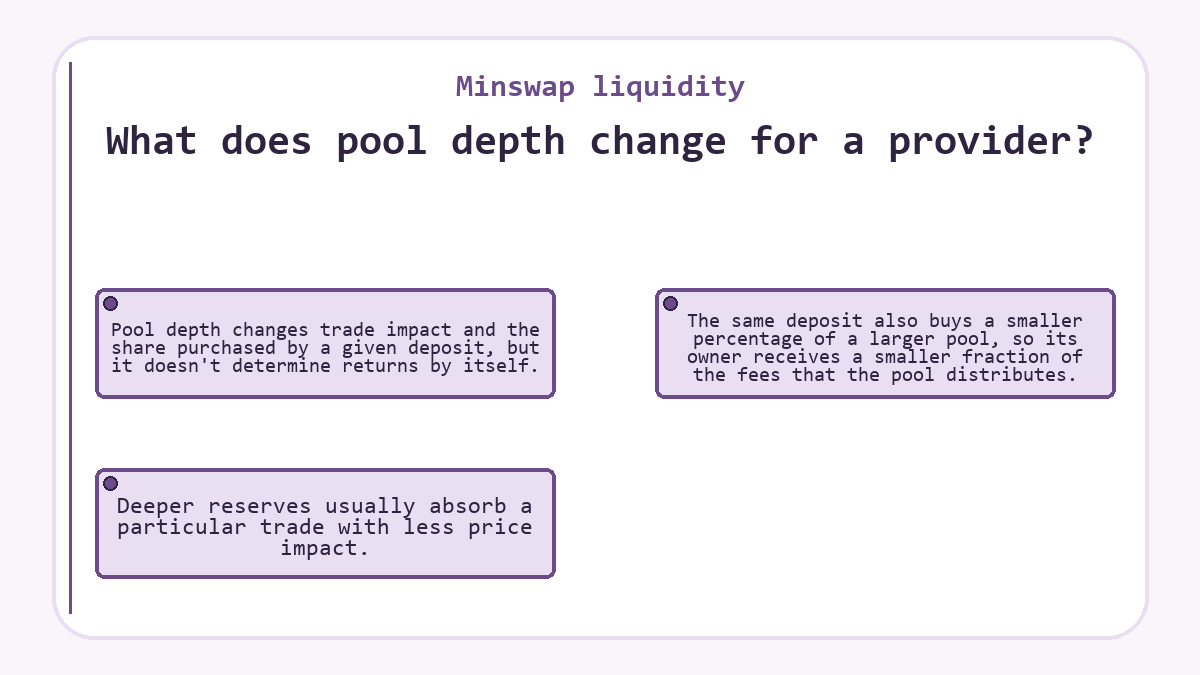
What does pool depth change for a provider?
Pool depth changes trade impact and the share purchased by a given deposit, but it doesn't determine returns by itself. Deeper reserves usually absorb a particular trade with less price impact. The same deposit also buys a smaller percentage of a larger pool, so its owner receives a smaller fraction of the fees that the pool distributes.
Read depth beside recent volume. A deep, lightly traded pool may generate little fee activity relative to its liquidity. A smaller active pool may display a stronger rate, but trades or departing liquidity can move its conditions more sharply. Check the live deposit quote because a historical reading can miss a recent change in reserves.
Fee APR needs volume and fee context
Minswap reports trading fee APR at the pool level.
Liquidity, trading volume, and the fee tier explain different parts of that figure. Volume shows how much trading passed through the pool during a stated period. The fee tier determines the charge applied to qualifying swaps, while total liquidity affects how widely providers share the collected fees.
The displayed trading fee APR is a changing estimate rather than a fixed payment rate. It moves as trading activity and supplied liquidity change. Use it to compare recent conditions, not to project an exact return over a future holding period.
A higher fee tier charges more on each applicable trade, but it doesn't prove that the pool earns more. Traders may use that pool less often, or its volume may arrive in irregular bursts. Compare the tier with actual volume across more than one observation period.
Keep trading fee APR separate from any farm incentive. Pool fees arise from swaps, while farm rewards follow a distinct incentive program with its own eligibility and duration. Combining the two rates without checking their components can hide which part may change or end.
How does asset divergence change the position?
Asset divergence changes the quantities held by the pool and can leave an LP position worth less than the original assets held separately. As traders move the pool toward the wider market price, the reserves shift toward the asset that has underperformed and away from the one that has outperformed. LP tokens continue to represent a share of that changing mix.
Impermanent loss measures this relative shortfall against holding the starting assets. Trading fees or incentives may offset it, but they don't guarantee that outcome. Pairs expected to track one another may face less routine divergence, yet that relationship can break. Compare the reason for the expected price relationship rather than relying on a label alone.
Pool type and token identity determine compatibility
Minswap Stable Pools use a pricing curve designed for assets intended to trade near the same value. That design depends on suitable asset relationships and correctly configured parameters, including token decimals. It doesn't remove the consequences of a depeg, faulty metadata, or an unsuitable pairing.
Compatibility also begins with token identity. Matching symbols can refer to different Cardano native assets, so compare the underlying policy ID and asset name before considering depth or APR. The chosen pool, exact pair, and deposit route must all refer to the intended assets. A familiar ticker can't repair a mismatch at that level.
A compatibility check before committing funds
Compatibility determines which deposit routes work with the selected assets, pool, and wallet. Confirm the quoted operation before relying on the APR comparison. If neither Zap-In nor a paired deposit is supported, choose a compatible pool.
Worked compatibility example. Every amount, compatibility condition, and displayed output in this example is hypothetical. A reader holds 2388 units of a starting Cardano asset, doesn't hold the paired asset, and wants exposure to a selected two-asset pool.
Normal path. The pool recognizes the exact starting asset, the wallet can authorize the transaction, and Zap-In produces a valid quote. Before route costs, the operation allocates 1194 units to the starting side and 1194 units for conversion into the paired asset. Confirmation completes the addition, and the quoted LP token amount appears in the wallet.
Edge case. A matching ticker points to a different asset identifier, or the selected pool doesn't support that Zap-In route. No compatible quote appears, so the reader stops before signing. The fallback is a paired deposit after obtaining the exact second asset through a supported route. If that route is also unavailable, the reader must select a compatible pool.
Before signing, the reader proceeds only when the preview shows the intended assets and expected LP-token amount.
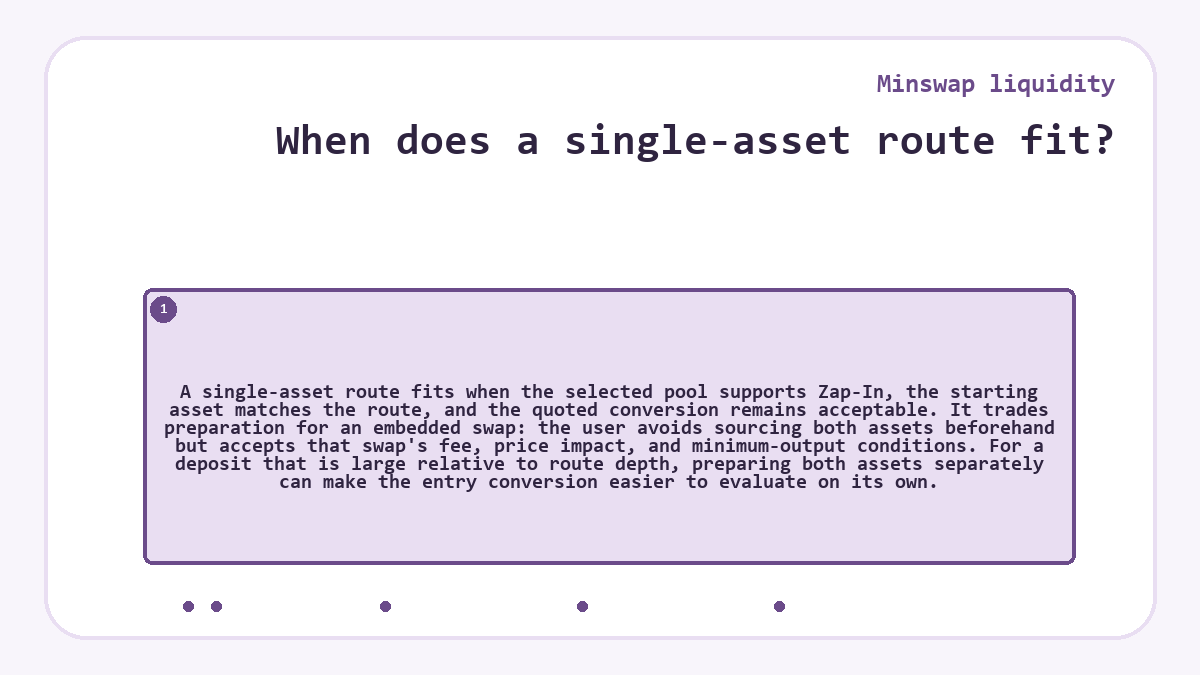
When does a single-asset route fit?
A single-asset route fits when the selected pool supports Zap-In, the starting asset matches the route, and the quoted conversion remains acceptable. It trades preparation for an embedded swap: the user avoids sourcing both assets beforehand but accepts that swap's fee, price impact, and minimum-output conditions. For a deposit that is large relative to route depth, preparing both assets separately can make the entry conversion easier to evaluate on its own.
Exit conditions belong in the comparison
An exit comparison begins with the assets the user wants back. Standard removal redeems LP tokens for both reserve assets in proportion to the position. Zap-Out combines removal with a conversion when a compatible route can return one selected asset instead.
The single-asset exit is convenient, but the added swap introduces another fee, price impact, and minimum-output condition. A thin route can therefore make Zap-Out less attractive even when the underlying liquidity position is large. Review the exit quote rather than assuming entry depth guarantees the same conditions later.
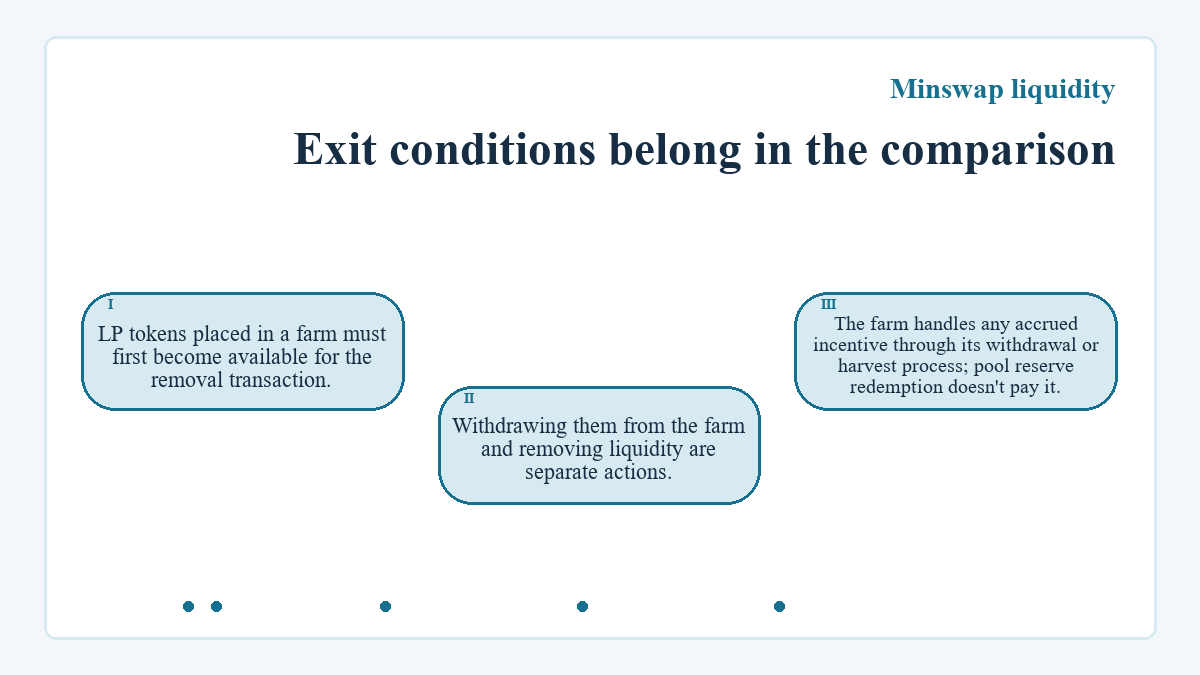
LP tokens placed in a farm must first become available for the removal transaction. Withdrawing them from the farm and removing liquidity are separate actions. The farm handles any accrued incentive through its withdrawal or harvest process; pool reserve redemption doesn't pay it.
Keep enough Cardano native currency outside the position for later network costs. That reserve preserves the ability to leave a farm, remove liquidity, or complete a supported Zap-Out without selling part of the position merely to fund the exit transaction.
Quick answers about Minswap liquidity
Does adding pool liquidity start farming rewards automatically?
No. Adding liquidity creates LP tokens and exposure to the pool's trading fees, but farming is a separate action available only for eligible pools. To earn an offered farm incentive, the LP tokens must enter the relevant farm. Trading fees and farm rewards come from different mechanisms, so compare them separately and check whether the incentive has additional conditions or a limited duration.
How much Cardano native currency should remain outside the position?
No fixed amount works for every deposit because transaction costs and later actions differ. Keep enough native currency for the initial deposit and the later steps you may need, such as entering or leaving a farm, harvesting rewards, removing liquidity, or using Zap-Out. Read each transaction preview before signing instead of committing the wallet's entire available balance.
Can a pool's fee setting change after liquidity is added?
Yes, a pool's fee can change when its fee-management rules authorize an adjustment. The value displayed before a deposit describes the current terms, not an immutable rate for the position's lifetime. A changed fee affects what future swaps pay and therefore the fee stream that providers share. Recheck the live fee tier when reviewing performance or deciding whether to remain in the pool.
Is token verification enough to select a Minswap liquidity pool?
No. Token verification can help confirm identity and metadata, but it doesn't establish sustained trading volume, suitable pool depth, price stability, or future fee income. It also doesn't remove asset divergence or smart contract risk. Use verification to confirm what asset you're evaluating, then assess the pool's economics, route compatibility, and exit method separately. An identity signal isn't a quality guarantee.